Miniware TS21 Soldering Iron – Tiny and Powerful, But Is It Good Choice For FPV Drones Builders?

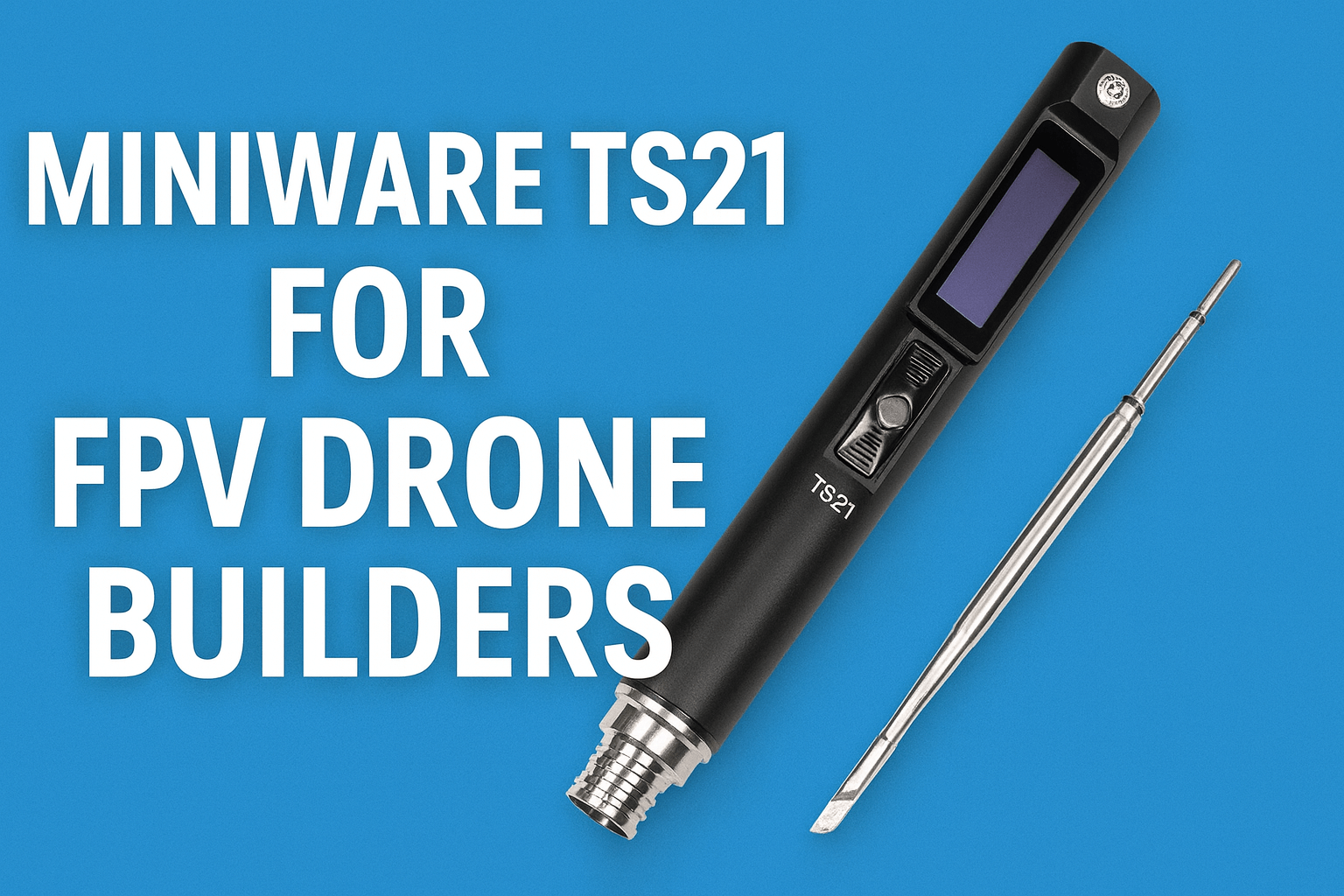


In the box, you’ll find:
- The soldering iron body
- A soldering tip (the TS21-KU blade tip)
- A set of colored heatshrink for the handle
- A manual
Design and Build
Right out of the box, the TS21 feels premium. The aluminum alloy body gives it a solid, durable feel.

It’s noticeably more compact compared to older models like the TS80 or TS101, making it the smallest Miniware soldering iron to date. Despite its compact size, it weighs about the same as the TS100 and TS101 — still light enough for precision work.

The design is sleek and functional:
- OLED Display: A bright 0.91-inch screen shows temperature, modes, and menu options.
- Controls: Two buttons on the body for quick adjustments and navigation.
The soldering tips are smaller in diameter than those used on the TS80 or TS101. They slide in and lock with a simple click, making tip changes fast and secure.

When I first opened the box, I was a bit puzzled by the colored heatshrink — until I realized they’re meant as anti-slip grips for the handle. You can shrink one onto the body with a hot air gun for better comfort and a personalized look. Honestly, they’re optional — I’d only bother if sweaty hands are an issue for you.
Finally, the USB-C power port is located at the end of the iron. It supports 18–100W USB-C PD adapters, meaning you can run it off a high-power wall charger or even a PD-compatible power bank.

Features and Settings
Like other Miniware soldering irons, the TS21 comes with a settings menu that you can navigate with the two buttons.

Some of the key adjustable parameters include:
- Sleep mode timer
- Sleep temperature
- Working temperature
- Maximum power
The menu is intuitive and the buttons are responsive, making it simple to operate. The display also has auto-rotation, so the screen orientation instantly flips depending on which way you hold the iron.

One feature I particularly love is the temperature presets. You can set three custom temps and cycle through them instantly with a single click of the button. I have mine set at 450°C, 400°C, and 350°C for different jobs, which saves a ton of time compared to holding the button down multiple clicks just to adjust.

There’s also a built-in LED light near the tip that lights up your workspace. It’s surprisingly useful when soldering in low light or tight areas.


The sleep mode works perfectly too — when the iron rests in its stand, it automatically lowers the temperature, helping preserve tip life and save power.
Here’s the manual.

Performance Testing: Blazing Fast Heating
The heating speed of the TS21 blew me away. In my tests, it hit 450°C in under 5 seconds! That’s insane. For comparison, TS100 takes 13 seconds while the HGLRC RC2 takes 11 seconds.
This speed is partly due to the smaller soldering tip; less mass means less energy required to heat it. The upside is that it also cools down extremely quickly, reaching lower temperatures in just a couple of seconds.
Combined with the presets, this makes switching temps for different tasks nearly seamless.
Downsides: Small Tip Size
The compact tip has a big downside: it struggles with large solder joints that demand more heat. For example, when soldering an XT60 connector to a 4in1 ESC, I found myself holding the wires down for too long, which overheated the pad and almost burned my fingers. Not ideal for big jobs.

I really wish Miniware offered larger tips for the TS21. As it stands, it’s fantastic for micro drones (3-inch and smaller, including tiny whoops), but the tiny tip might struggle when working on heavy-duty builds like 5-inch and 7-inch quads with thick XT60 wires and high-current ESCs with a large amount of copper traces.
Power Consumption
Another observation: even though I set the TS21’s maximum power to 100W, it rarely came close. Using a 100W PD power bank, I monitored real-time usage and typically saw 50–60W, even during initial heat-up, which normally uses the most power. It still feels plenty powerful, but it’s worth noting if you expected it to consistently draw 80–100W.


Other Soldering Iron Tips
My TS21 came with two extra cone needle tips, which are clearly designed for precision work. Personally, I find the stock blade tip excellent for FPV builds — it strikes the right balance between precision and the ability to handle moderately large joints. Unless you do extremely fine electronics work, there’s little need to swap tips. That said, I do wish larger tips were available.

Also note that the TS21 tips are noticeably smaller than those used by the TS100 or TS101, and unfortunately, they’re not cross-compatible. You’ll need tips specifically designed for the TS21.

Is It Ideal for FPV Pilots?
The TS21’s lightweight design, rapid heating, and built-in LED light make it a joy to use. Swapping tips is quick and painless, and the compact size makes it easy to store and transport. For quick field repairs, FPV drone builds, or delicate electronics, it’s a very capable and versatile iron.
However, there is one drawback: the TS21 only accepts USB-C input. Unlike popular models such as the TS100, TS101, or HGLRC RC2 — which can be powered directly from a LiPo battery — the TS21 requires either a USB-C power bank (at least 100W) or a LiPo-to-USB-C adapter. This makes it slightly less flexible in the field.
Powerbank recommendation (get one that’s 100W or higher)
Final Thoughts

The Miniware TS21 is an excellent portable soldering iron that delivers insanely fast heating, a 450°C max temperature, and thoughtful features like sleep mode and an LED work light. While it’s not designed specifically for FPV, its compact form factor and reliability make it a strong option for field repairs and micro drone builds.
That said, the tiny tip size means it may struggle with larger solder joints like XT60 connectors and high-current ESC power pads. For those jobs, irons like the TS101 or HGLRC RC2 are more versatile choices:
For bench work, I recommend a proper soldering station like the AiXun T3A, which is currently my daily driver