
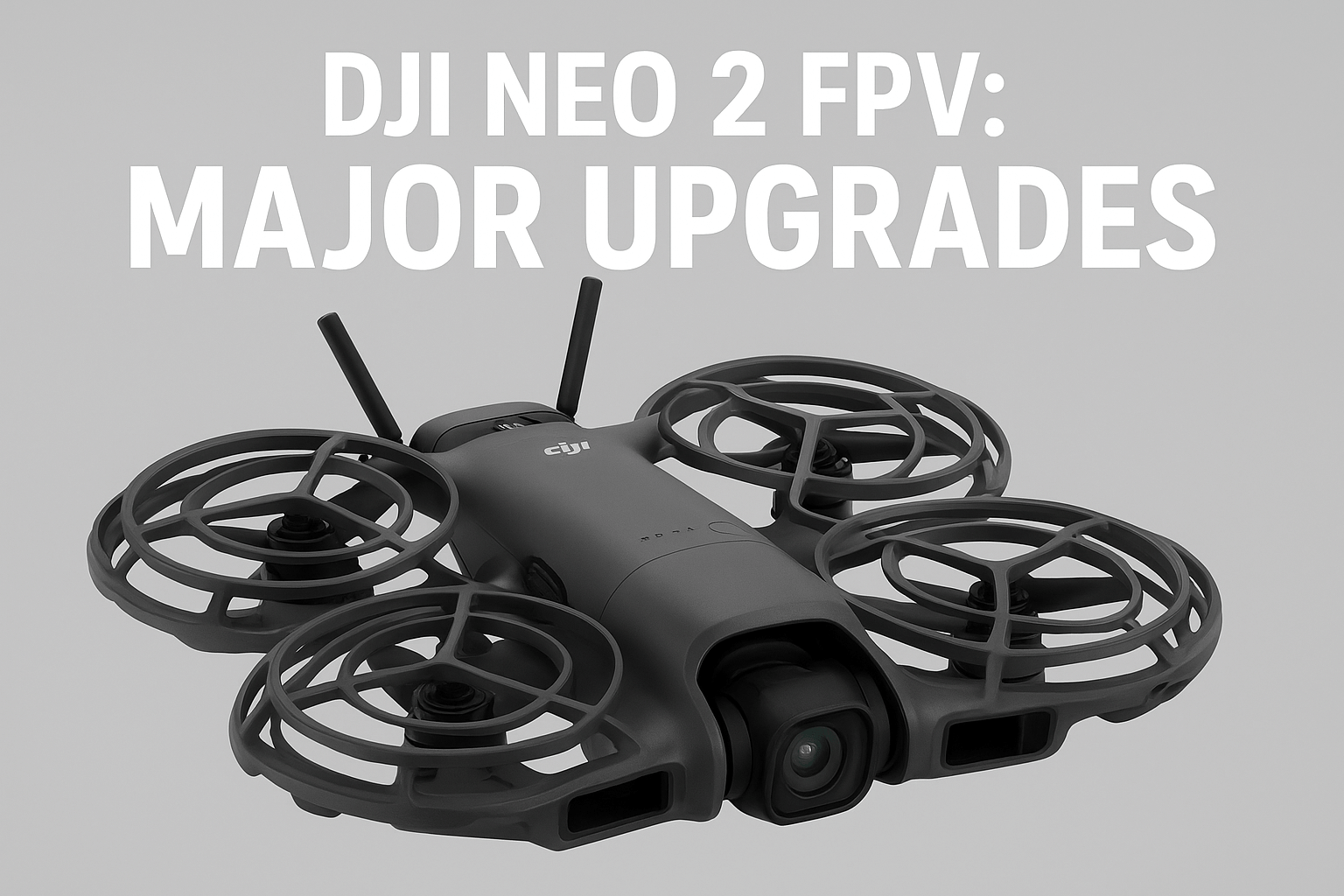


DJI Neo 2 Overview – What’s New?
The original Neo was designed as a beginner-friendly FPV drone, small, fun, and focused on AI flight features. Neo 2 appears to retain this concept, but with many improvements:
- Better 2-axis gimbal and image quality
- 360° obstacle sensing
- Increased battery capacity
- Quieter propellers
- Improved connectivity & range potential
- Slightly heavier, but remains well under the 250g limit
- Front-facing screen possibly for selfie mode and displaying camera information
Where to Buy
Launch Date: October 30th, 2025 (China), November 6th, 2025 (Rest of the world)
Rumoured Pricing:
- DJI Neo 2 drone $229
- Fly More combo $449
Due to current U.S. policies, the availability of DJI products in the U.S. may be limited or delayed. Other regions are expected to be unaffected.
Specifications
Specs comparison table: Neo V1 vs Neo V2
| Neo V2 | Neo V1 | |
| Camera Sensor | 1/2″ CMOS | 1/2″ CMOS |
| Video | 4K/60fps | 4K/30fps |
| Gimbal | 2-axis | 1-axis |
| Stabilization | RockSteady | RockSteady |
| Onboard Storage | 49GB | 22GB |
| Battery Capacity | 11.5Wh (1600mAh) | 10.5Wh (1435mAh) |
| Flight Time | 19 minutes | 17 minutes |
| Charging | USB-C | USB-C |
| Top Speed | 16m/s max | 16m/s max |
| Advertised Range | 10km (O4 transmission) | 10km |
| Weight |
| 135g |
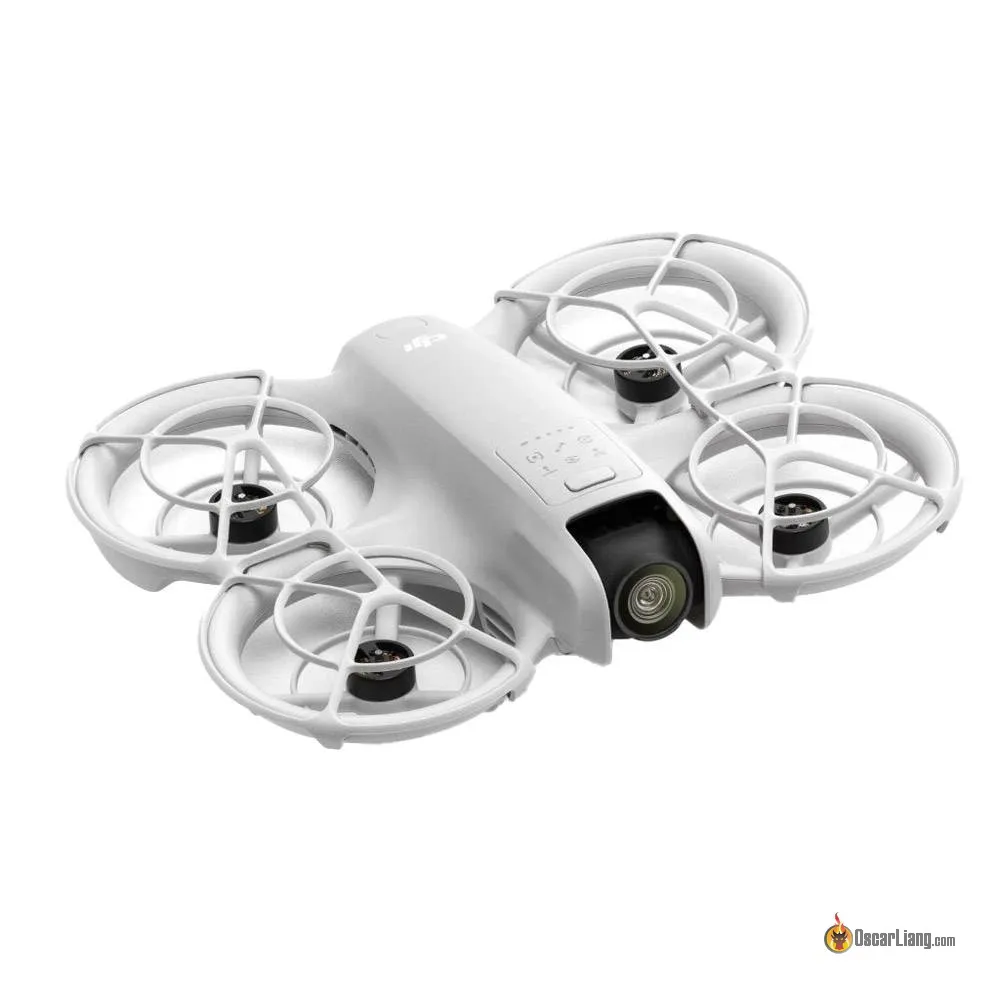
DJI Neo V1

DJI Neo V2
Image Quality & Gimbal Upgrade
The Neo 2 retains the same 1/2″ image sensor as the original, so we shouldn’t expect major improvements in dynamic range or low-light performance. However, based on the footage we’ve seen so far, DJI has managed to noticeably enhance overall image quality.
The biggest upgrade is the new 2-axis mechanical gimbal, replacing the single-axis tilt stabilization found on the original Neo. This should deliver smoother, more stable footage, especially during windy conditions, turns, and quick maneuvers.
There’s still no D-Log M support, and video is limited to 8-bit color, which might be slightly disappointing for people serious about color grading. Low-light shooting also remains underwhelming due to the small sensor. But to be fair, anyone buying the Neo 2 likely values its compact size and ease of use over pure camera performance. For casual pilots, the image quality is more than adequate.
Obstacle Avoidance Sensors
Neo 2 appears to improve tracking and safety by adding LiDAR sensors and expanding coverage in all directions:
- Front-facing IR/depth sensors
- Top-mounted obstacle camera
- Downward positioning sensors
- Likely rear detection as well
Benefits include:
- More reliable object tracking
- Smarter Return-to-Home (less risk of collisions)
- Safer indoor flights
- Fewer unexpected crashes
Battery Boost
The Neo 2 features a slightly larger battery (from 10.5Wh to 11.5Wh), and DJI claims the flight time has been increased to around 19 minutes per pack, a noticeable improvement over the original’s 17 minutes. However, real-world tests show closer to 13 to 15 minutes of actual flight time once you factor in the added weight of the transceiver module.
The USB-C charging hub can fully charge up to three batteries simultaneously in under an hour (65W). Considering the flight time, you’ll likely need to wait a bit between flights for them to recharge.
Unfortunately, here’s the bad news: replacement batteries now cost almost double, jumping from $69 for the original Neo to $129 for the Neo 2.
Quieter Propellers
One of the biggest complaints about the original Neo was how loud it was. The new propeller design should result in:
- Quieter operation
- Improved aerodynamic efficiency
Great news for urban flyers who want to avoid annoying neighbours.
Backward Compatibility
The Neo 2 works with existing DJI FPV gear, just like the original Neo:
- Goggles 3
- Goggles N3
- DJI FPV Remote Controller 3
This means current Neo users can upgrade more affordably.

Range & Control
The DJI Neo 2 ships as a WiFi-only drone, unless you purchase and install the new transceiver module. This optional module has two antennas and attaches to the back of the drone, enabling OcuSync connectivity so you can pair it with existing DJI FPV gear such as the Goggles 3 and RC 3 controllers. This setup offers:
- Reduced control latency
- Extended range, easily over a mile (the real bottleneck will be the battery life)
Without this module, the Neo 2 can only be flown over short-range WiFi or via hand gestures, meaning you can control and record with it completely without a remote.
The transceiver module is sold separately, but it’s included in the Fly More Combo. Note that this module weighs nearly 10 grams, so you will lose some flight time using it.
Limitations
The Neo 2 uses a 2-axis gimbal, not a 3-axis one, so you may still notice some shakiness in windy conditions. However, the built-in RockSteady software stabilization does a good job of smoothing things out, and the footage still looks impressively stable for casual flying.
The drone also has a height limit of 120 meters. It won’t fly higher than that and will simply hover in place if you try to exceed it. This is much lower than the Avata 2’s 500-meter ceiling.
There’s no SD card slot, meaning you’ll need to rely on the 49GB of built-in storage for saving your videos. For most casual pilots, though, that’s plenty of space.
Final Thoughts
The original Neo was designed as a beginner-friendly drone but was held back by several performance limitations, a heavy frame, a relatively weak motor and prop combination, and Li-ion batteries that traded power for longer flight time. It worked, but it never quite felt like a true FPV quad. Image quality was also lacking. If you’re after performance or freestyle/racing capability, a custom-built FPV drone is still the way to go.
The Neo 2 retains a similar frame design and power system, so don’t expect significant improvements in flight performance. However, it does deliver upgrades in image quality and obstacle sensing. It also offers unique advantages such as AI tracking, ease of use, and ready-to-fly convenience, no soldering, no tuning, charge and fly.
For hardcore FPV pilots, the Neo 2 might feel a bit underwhelming. But for casual flyers who simply want a compact drone that’s easy to operate, shoots decent video, and adds safety features like obstacle avoidance, the Neo 2 could be worth considering. But if you prioritize image quality, the Avata 2 is still better with its 1″ camera sensor. It also flies better and longer thanks to the more powerful motors/propeller and bigger battery. The higher height limits also make it more suitable for flying in nature.
The Neo 2 clearly targets a specific group of users: beginners who don’t want to build or configure a drone, and casual pilots who value intelligent flight features over raw performance.
As soon as it’s officially released, I’ll be picking one up for a full hands-on review, flight testing, and camera comparison.